Why Talanoa Is Your Best Networking
Strategy
Why Talanoa Is Your Best Networking Strategy
Discover talanoa, the Pacific art of authentic conversation, and learn how showing up as yourself — not “working the room” — builds trust that turns into referrals and repeat clients.

You know the feeling. You walk into a networking event, name tag on, business cards ready, and within twenty minutes you’ve had twelve conversations and remember none of them. Everyone was “working the room.” Nobody actually talked.
There’s a better way, and it comes from a tradition that’s been building trust between people for centuries: talanoa.
Talanoa networking isn’t a hack or a script. It’s a mindset borrowed from Pacific Island culture — one that trades performance for presence, and small talk for real talk. And it turns out that mindset is exactly what modern business relationships are missing.
What Is Talanoa? A Pacific Tradition of Honest Conversation
Talanoa is a Fijian and broader Pacific Island concept, roughly translating to storytelling or conversation without a hidden agenda. It’s used in everything from village gatherings to international diplomacy — the Talanoa Dialogue even became a formal framework in global climate negotiations, built on the idea that people reach better outcomes when they share stories openly, without blame, and truly listen to one another.
At its core, talanoa rests on a few simple commitments:
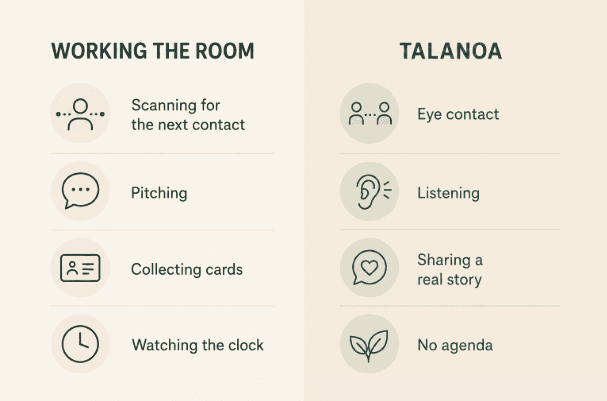
- No fixed agenda. The conversation is allowed to go where it needs to go.
- No concealment. People speak honestly, not strategically.
- Everyone listens as much as they talk. It’s a shared exchange, not a pitch.
Notice what’s missing from that list: an ask. Talanoa isn’t a means to an end. It’s the relationship itself.
Why “Working the Room” Fails to Build Real Trust
Traditional networking advice trains us to optimize. Collect contacts. Perfect the elevator pitch. Move on before the conversation gets “unproductive.” It treats every interaction as a transaction to be completed as efficiently as possible.
The problem is that people can feel it. When someone is scanning the room over your shoulder for the next contact, or steering every conversation back to what they’re selling, it reads as exactly what it is: self-interest wearing a friendly face.
Business leaders have started to say the quiet part out loud. In a Harvard Business Review conversation on networking, longtime Silicon Valley connector Heidi Roizen put it bluntly: reaching out to someone only because you want something from them “just doesn’t feel good” — and people notice. Roizen’s advice echoes talanoa almost exactly — you build the relationship before you need it, not in the moment you need it.
The Talanoa Mindset: Presence Over Performance
Shifting from “working the room” to talanoa networking doesn’t mean abandoning intention. You can still walk into an event hoping to meet the right people. What changes is how you show up once you’re in the conversation.
Presence over performance means:
- Asking a question because you’re curious, not because it’s your opener.
- Letting a conversation run long instead of cutting it short to “network efficiently.”
- Being willing to talk about something other than work.
- Admitting when you don’t have the answer, instead of performing expertise.
This is uncomfortable for a lot of business professionals, because it feels inefficient. But talanoa isn’t inefficient — it’s just optimized for a different outcome. It’s optimized for trust, and trust is the actual currency of business relationships, not contact volume.
How Authentic Conversation Builds Business Trust
There’s a well-documented psychological principle behind why this works: reciprocity. When someone offers something genuine — real attention, a real story, real vulnerability — people tend to feel an instinct to respond in kind. Talanoa creates the conditions for that instinct to kick in naturally, because it starts from honesty rather than strategy.
Compare that to a transactional pitch, which invites a transactional response: polite deflection, a business card exchange, and no follow-through. A real conversation, on the other hand, tends to be remembered — and people do business with people they remember, and trust.
This is the piece most networking advice skips: trust isn’t built in the moment you ask for something. It’s built in all the moments before that, when there was nothing to gain except the relationship itself.
From Trust to Referrals: The Business Case for Talanoa
Here’s where talanoa networking stops being a nice philosophy and starts being a growth strategy.
Referrals and repeat business don’t come from people who remember your title. They come from people who trust you enough to put their own reputation behind a recommendation. That level of trust is earned through consistent, authentic interaction over time — not a single well-executed pitch. (It’s the same principle behind how small businesses build a loyal following from scratch — consistency and honesty beat any single clever move.)
When you practice talanoa:
- People refer you more confidently, because they actually know how you think and work, not just what your business card says.
- Clients come back, because the relationship didn’t disappear the moment the invoice was paid.
- Your network becomes self-sustaining, because trust compounds — every honest conversation makes the next one easier.
In other words, talanoa isn’t the “soft” alternative to strategic networking. It is the strategy — it just plays out on a longer timeline than a single event.
How to Practice Talanoa at Your Next Networking Event
You don’t need a Pacific Island gathering to bring talanoa into your next conference, mixer, or client dinner. A few practical shifts:
- Pick fewer, deeper conversations over more, shallow ones. Two real conversations beat twelve rushed ones.
- Ask questions you actually want the answer to. Curiosity is the easiest way to signal you’re not performing.
- Share something true, not just something polished. A real challenge you’re working through often builds more trust than a highlight reel.
- Let silence happen. Talanoa doesn’t rush to fill every pause with a pitch.
- Follow up like a person, not a lead-gen system. Reference the actual conversation, not a generic template.
None of this requires more time than traditional networking. It requires a different intention. It’s the same relationship-first approach behind how we work with every client here at Talanoa Marketing.
Turning One Conversation Into a Repeat Client
The real test of talanoa networking isn’t the first conversation — it’s what happens after. Because the relationship wasn’t built around a transaction, it doesn’t end when the transaction does.
That’s what turns a single project into a repeat client, and a repeat client into a referral source. The trust built in an unhurried, honest conversation carries forward, quietly doing the work that no cold outreach campaign can replicate.
Networking doesn’t have to feel like a performance you have to survive. Talanoa offers a different way in — one built on presence, honesty, and the kind of trust that actually turns into referrals and repeat clients.

Ready to build relationships that actually last? Book a conversation with us or subscribe for more relationship-first business insights.